How Arion compares to other competitor tools
A side-by-side look at data capture, review workflows and analytics across the leading EDC platforms — and where a single-database architecture changes the operational story.
Request a demoWhere a single-database architecture changes the operational story
Comparison points reflect common patterns across competitor tools and public product documentation checked in August 2026. Not exhaustive — every platform is broader than one table can capture.
| Dimension | Arion | Other competitor tools |
|---|---|---|
| Capture & analysis | One database — nothing to export to analyse | Often exports to a separate analytics layer or module |
| Study build | AI-assisted protocol & spreadsheet extraction | Configuration options vary; some require specialist build support |
| Data quality workflow | Saves are never blocked; findings become queries | Configurable edit checks; behavior varies by implementation |
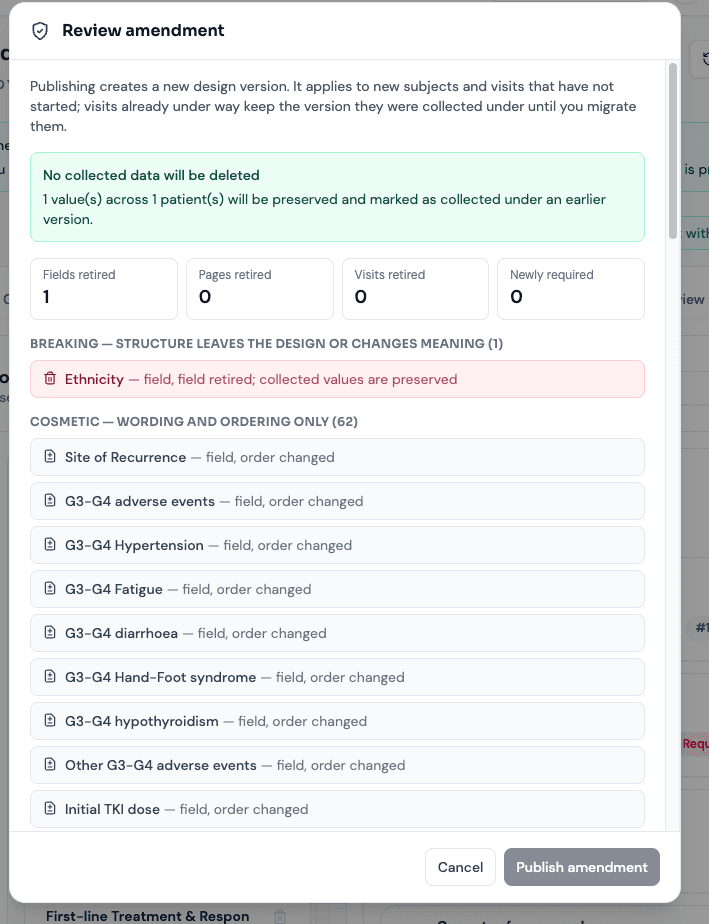
| Mid-study change control | Structural edits show the exact patient-data impact before you confirm | Protocol amendments are supported; impact visibility varies |
| Source data verification | Event, page and field levels, with inheritance | Targeted or configurable SDV, depending on the platform |
| Role-based access | 13 roles, org- and center-scoped out of the box | Configurable roles; scope and defaults vary |
| eCOA / remote capture | Built in — access-code protected mobile forms | Often a separate eCOA or ePRO module |
Sources: public product documentation and market materials, current as of August 2026.
Publishing to production is one-way; amendments are versioned
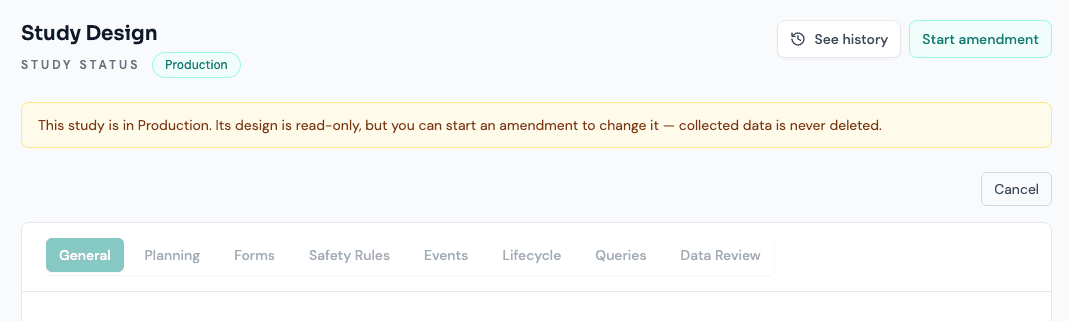
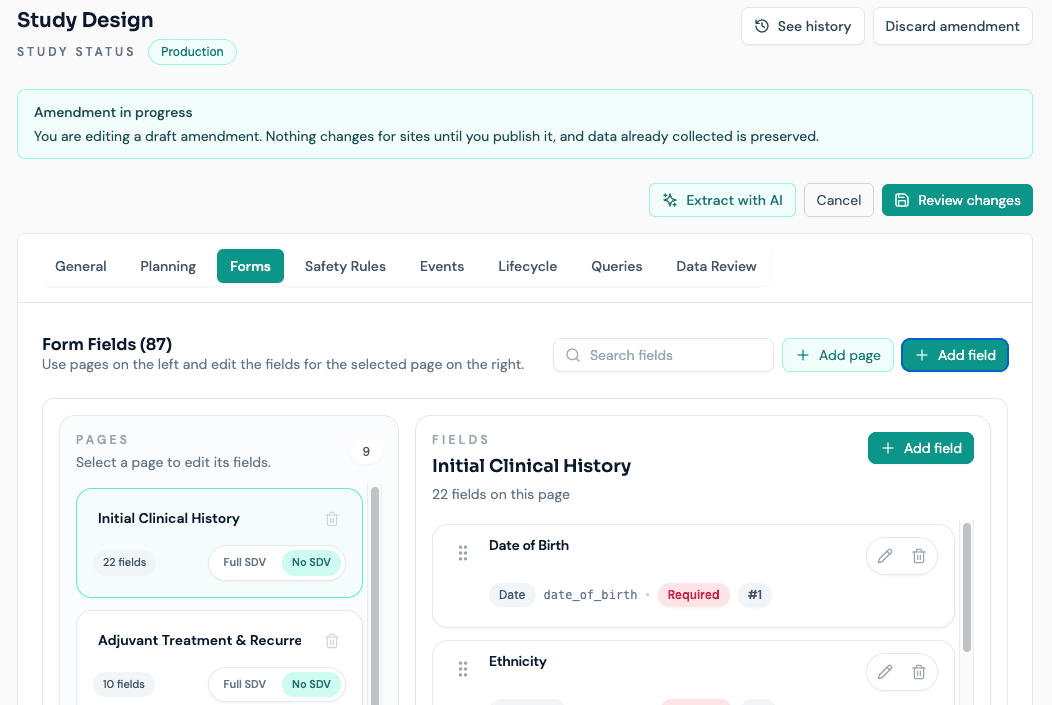
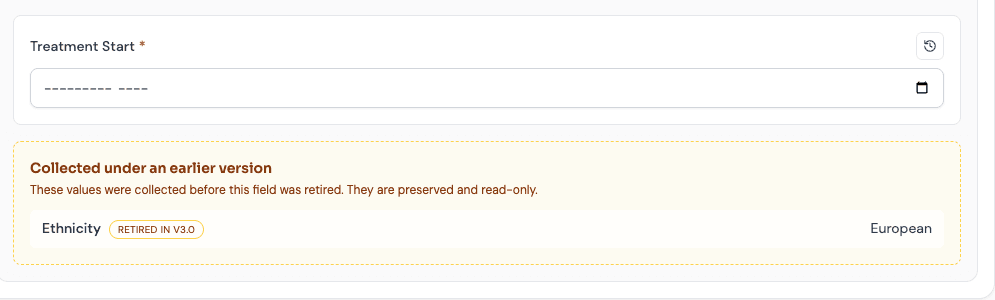
Arion keeps testing and production explicitly separate, so nobody can accidentally publish disposable test data as a live study. Once live, the design changes through a reviewed amendment draft that publishes a new version and preserves collected data. The new version applies to new subjects and visits not yet started; existing visits retain their collection version until explicitly migrated.
Study status moves forward. The production design keeps evolving through explicit versions.
No rollback to testing, but production studies can evolve through controlled, auditable amendments.
Change the live design without losing what happened before
- 01
Publish deliberately
A typed confirmation moves the tested study into production and clears disposable test data.
- 02
Work in a private draft
Authorized builders start an amendment while sites continue working with the published version.
- 03
Review the real impact
Arion separates structural and cosmetic changes and shows affected patient data before publication.
- 04
Publish without erasing history
The new version applies prospectively. Earlier collected values stay preserved and attributable.
Actual Arion production and amendment workflow
What people ask before switching
What is the difference between an EDC and a CDMS?
EDC (Electronic Data Capture) usually refers to the data-entry layer — the eCRF. A CDMS (Clinical Data Management System) adds review workflows like queries and SDV on top. Arion is both: capture, review and analytics in one platform, so the distinction stops mattering operationally.
Is Arion an alternative to other competitor tools?
For sponsors and CROs who want study design, capture, review and analytics in one system rather than a multi-tool workflow, yes. Arion is a focused, single-database alternative rather than a like-for-like feature match with every broader competitor platform.
How long does it take to launch a study?
AI-assisted protocol and spreadsheet extraction gets a first draft of the study structure in minutes rather than weeks, but the real timeline depends on protocol complexity and how much review your team wants before publishing to production.
Does Arion support decentralised or remote data collection?
Yes — the eCOA module delivers access-code protected, signed-token public forms over SMS invitation, so patients can complete assessments on their own device without a separate ePRO system.
Is Arion GDPR compliant?
Arion acts as a data processor under GDPR, with a Data Processing Agreement accepted at organization creation. See the Security page for the specific mechanisms — audit trail, access control, and hosting.
Can Arion run alongside our existing CTMS or eTMF?
Arion is focused on eCRD/EDC — study design, data capture, review and analytics. It doesn't replace a CTMS or eTMF, and integration with those systems is evaluated case by case rather than shipped as a packaged connector today.
See it on your protocol
Bring a protocol or an existing study and we'll show you what this looks like in Arion.